Sunday, November 4, 2012

Frankenstein (1931)

By the 1930's, Universal Studios was in a huge financial crisis. To try to clear some of the debt the studio released two relatively cheap pictures (those being Dracula and Frankenstein). Lucky for the studio, both films were extremely successful.

Frankenstein, directed by James Whales, is based on the story of the same name by Mary Shelley. The film is a prime example of Gothic horror. Gothic horror often contains elements of romance in addition to horror and is largely characterized by the atmosphere of the film. Often times, films that make use of monsters or supernatural creatures like the Frankenstein monster or Dracula are considered to be or contain elements of Gothic horror.

From the moments the film begins we can already see glimpses of such horror. As a funeral service commences, the scientist Frankenstein and his henchman Fritz look on from behind a tombstone. After stealing the coffin from its grave and another body hanging from the gallows, Frankensteins claims that the brains are not useful, and they must find a proper brain for the experiment. It is when the return to Frankenstein's laboratory that the true horror of the situation can be felt. The castle-like tower, resting high upon the cliff, surrounded by dark storm clouds and thunder are all staples of Gothic horror. The atmosphere lays the pretense for the horror that is to come. 

Frankenstein's fiance, Elizabeth, expresses her worries over her husband's absence to her friend, Victor Moritz. They go to Dr. Waldman, Frankenstein's old medical professor, to ask what Frankenstein has been up to. After revealing that he is trying to create life from the dead, the three travel to Frankenstein's laboratory. Reluctantly letting them in, Frankenstein leads Elizabeth and the gentlemen to the room in which the monster is to be born. Through an over-the-top sequence the platform upon which the future monster rests is raised into the sky. Electric nodes and other technological marvels flash as lightning strikes the beast into life. Another element of Gothic horror, the extravagant show serves to wow the audience and strike awe in such a way that it can soon thereafter be converted into fear. Indeed, as the Frankenstein monster comes to life, it appears to be docile at first. But at the incompetence of Fritz the monster panics in fear, which is appears to be an act of aggression to its onlookers. 

The monster is locked in a dungeon, where he later strangles Fritz. Frankenstein, after realizing the horror of his experiment, drugs the monster along with Dr. Waldman, almost dying in the process. After Frankenstein leaves to prepare for his wedding, Dr. Waldman begins to operate on the monster and unexpectedly awakens him. The Frankenstein monster strangles Dr. Waldman and escapes into the countryside. 

In what may arguably be the best moment of the movie, the monster happens upon a young girl named Maria who wants to play with the beast. Maria shows him how the flowers float when thrown into the water. The creature becomes excited and in its blindness throws the young girl into the water, hoping to see her float. When the girl does not return to the surface, the monster runs in agony towards the city. This moment is so crucial to the portrayal of the monster-- in the flash from peaceful playtime to pure horror it is revealed that the monster "knows not what it does."  

With preparations of his wedding complete, Frankenstein and Elizabeth wait happily for the arrival of Dr. Waldman. Victor rushes in and informs the couple of the doctor's death. After Maria's father arrives with his child's dead body, Frankenstein's suspicions about the monster's involvement are confirmed. Along with an angry mob of townsfolk, Frankenstein rushes off into the mountains to find the creature. 
After being split from the group, Frankenstein comes face to face with his creation. After a short standoff, the monster knocks Frankenstein unconscious and carries him to the top of an old wood mill while being chased by the villagers. Blinded by rage and fear, the monster tosses the body of Frankenstein from atop the mill. The fall is broken by the windmill planes and Frankenstein is carried back to the city. The remaining villagers burn the windmill to the ground with the monster inside. 

Frankenstein truly stands the test of time, even in this day and age. There may be a few slow moments but the majority of the film flows between tension and awe at the new life that has been created. What's most remarkable is how, by the end of the film, the audience may even feel pity for the creature, who was truly misunderstood from the moment it was born. 

Tuesday, October 16, 2012

Nosferatu: Symphony of Horror

Nosferatu (1922), directed by F.W. Murnau, is another classic example of German Expressionism, much like The Cabinet of Dr. Caligari. However, instead of infusing themes of death, terror, and plague directly into the world in which the characters live, Murnau chose to fuse these together into Nosferatu himself.


The story begins with a man named Thomas Hutter, who is sent by his employer to Count Orlok's castle. Count Orlok is deemed a potential costumer to an abandoned home directly across from that of Hutter's. After warnings from locals at the inn where he spent the night, Hutter continues to Orlok's castle. When his coachmen declines to take him any closer to the castle, a coach draped in black appears to take Hutter the rest of the way.


After being dropped off by the mysterious coach, Hutter comes face to face with Count Orlok. Immediately from his appearance we may recognize that something is not normal here. This land (far removed from Hutter's hometown) and its occupant are representations of the uncanny, strange, and horrible. Hutter's visit to Count Orlok's castle inevitably brings the normal world and the uncanny together.

At dinner, Hutter cuts his thumb while eating food. The Count tries to suck the blood from Hutter's thumb, not wanting it to be wasted, but Hutter refuses. After waking up to puncture wounds on his neck, Hutter goes over the contract with Orlok. While going over the contract for the deserted home, The Count sees a picture of Hutter's wife, Ellen, and decides to purchase the home ("What a beautifully long neck she has," says Orlok.) That night, Hutter reads over a book he found at the inn about the "bird of death" (aka Nosferatu). Suspecting Orlok, he stays awake in his room until Orlok arrives in the middle of the night, revealing his true nature. Hutter falls unconscious at the sight of Orlok.


This is where we see the disgusting figure of Orlok fully for the first time. The shape of his body symbolizes that which is horrible. His sharp, beak-shaped nose, dark eyes, bald, pointed head, and grotesque fingers are all unnatural. The Count's exaggerated features mark the film as an example of German expressionism, which used unrealistic, exaggerated visuals to express feelings of horror, fear, and threat.

The true horror occurs when Orlok enters the world of the normal. The next day, Hutter awakens to find the Count sleeping in his coffin. In the evening Hutter watches in horror as Orlok stacks up coffins at an unnatural speed to be shipped to Hutter's home town. The under cranking is used effectively to give Orlok a super-human ability (speed). Hutter hurries home at the sight.


The coffins are transferred from raft to ship. A crew member pries open one coffin, allowing rats (a symbol of disease!) to pour into the ship. Soon after this, crew members are picked off one by one. One of the final crew members investigates and finds Orlok, who kills him and the captain of the ship. When the ship arrives, nothing is found but the rats and an old ship log, so the deaths are attributed to a plague. Meanwhile, we see Orlok carry his coffin to his newly purchased home.


Ellen awakens one night to find Orlok staring at her from across the way. She discovers that the only way to kill him is to expose him to sunlight, and he must be distracted by a beautiful woman for this to occur. After her first attempt her husband leaves, and Orlok makes his way to Ellen's bedroom. We see Orlock's shadow as he ascends the steps to Ellen's bed-- fear and death making its way into normalcy.
Orlok is distracted until sunrise, and dies in a puff of smoke. Hutter makes it back just before Ellen dies.  We then see Orlok's castle crumble to the ground.


As an example of expressionism, Nosferatu serves to capture feelings of dread and horror, transporting them into the normal world. Unfortunately, this film hasn't aged all too well, and drags in many moments. While the key moments are exciting, the rest of the film makes them fall flat.


Tuesday, September 25, 2012

Suspiria


Dario Argento's 1977 horror flick Suspiria is considered by many a classic, stealing a spot on many critics' lists of best horror films. The film falls under a category of Italian films known as 'giallo,' meaning 'thriller.' Amongst English scholars/critics this term is used specifically to describe the Italian produced thriller and horror films, and this film serves as one of, if not the, primary examples of the genre. Suspiria is generally praised for its vivid cinematography and accompanying soundtrack (performed by Italian progressive rock band Goblin). 

Taxi, I said the dance academy, not the creepy rape forest...

Indeed, Suspiria's visuals are presented quite beautifully, right from the get go. The film begins with protagonist Suzy Banyon (Jessica Harper) arriving in Munich, Germany to enter a ballet academy. On a stormy night, Suzy's taxi meanders through a random spooky forest, eventually reaching the dance academy. As Suzy approaches the entrance, a student is seen fleeing the building while muttering some words hysterically. Once Suzy realizes she won't be getting into the academy that night, the focus shifts to the fleeing student. 

The killer always gets his victims to make funny faces before he kills them. Fact. 

The student, having fled to a friend's apartment complex to spend the night, is promptly murdered by an unseen figure (surprise!). The friend managed to get caught up in the killing as well (of course). With the focus shifting back to Suzy, we follow her into the school were the headmaster and teacher are introduced. Suzy meets her fellow classmates and then manages to faint during her first dance practice. From here on, the strangeness of the academy slowly begins to reveal itself, as Suzy is quartered to her bedroom and ordered to stay in the academy until she is better.

The thing about Suspiria is that based on plot alone, it's rather dull. Not much of it makes sense, and it kind of just... happens. After the first murders occur, the film kind of trots along with a thing or two happening here or there, until it's time for the film to end. BUT, this film is not known for its plot. There's a lot of visual elements to this film that really make it a worthwhile view-- and if you know what to look out for before you watch it, you'll have a much better experience. So without further ado...

**spoilers**

Visually, Suspiria is presented as a messed up fairytale. As soon as Suzy exits the airport and jumps in the taxi, she enters this fairy tale head on. The spooky forest separates normal society from the academy, and the visuals from here on incorporate bright, saturated colors that emphasize the childish quality of fantasy stories. The apartment complex that contains the first deaths is a bright, bright red, and is filled with symmetric geometry, creating an uneasy visual that is quite appropriate for the site of a murder. 

My eyes are bleeding.  Argento, you win this round. 

In contrast, the dance academy entrance is a deep blue, and appears quite welcoming. When Suzy is later taken to her room, we see that the narrow hallway of the girls' dorms is a deep shade of red. The doors themselves have very high doorknobs, making the women appear as young girls. This representation of infancy is further accompanied by the aforementioned hallway, which symbolizes the birth canal. 

Oh, this brings back the good ol' memories, right mom?

So the students are made to appear as infants in this fairytale-- but why? Turns out the academy faculty are witches, led by the originator witch who feeds upon their youth. Oh ok, cool. The representation of infancy is taken one step further when raining maggots force the girls to retreat to a giant hall, where their beds are surrounded by a giant sheet (symbolically, the womb). 

The womb, aka gossip central. 

So how about that part where the dog eats the face off of his owner? Maybe the dog was bewitched, or maybe he was tired of sitting outside the academy everyday for hours on end. Either way, he picked a good spot to have his late night snack-- turns out that coliseum was the site of various Fascist party rallies back in the day. 

Seriously, screw this. 

The jump cut to the German dance hall before this bit may seem random, but it actually serves as a political/societal connection within the film. The infancy of the women students is juxtaposed to the dance hall and coliseum scene to signify the infant like mind set that many members of a Fascist society have.

Yeah, this seems like a good place to walk the dog. 

About this time Suzy stops drinking the medicated wine that was actually keeping her confined to the academy. After the disappearance of her friend Sarah (who dies by jumping into a pit of barbed wire while trying to escape her killer), Suzy meets with Sarah's colleagues to make some sense of what's going on in the academy. She learns that the originator was rumored to be a witch, and that a witch's followers cannot survive without the witch herself. Suzy then remembers the words that were muttered by the first student whom she ran into (Iris, secrets, blahblah). Returning to the academy, she finds the irises painted on a wall and discovers a secret passageway.

Suzy's late for a very important death I MEAN date. 

In a dream like tunnel akin to various fairytale pathways (think Alice in Wonderland), Suzy makes her way to the den that houses the academy faculty, AKA the witch's followers, who are plotting to kill Suzy. She stumbles into the den of the witch, who reanimates the bloody body of Sarah. Suzy manages to kill Sarah and the witch (thus killing the witch's underlings in doing so). As the building begins to go up in flames, Suzy makes a hasty exit to normalcy. 

The servants are nothing without their undead master.

The buildup to Suzy's discovery so disturbingly creates tension and unease within the audience by using "the uncanny." The familiar concept of the fairytale is twisted and revealed to be not so kid friendly in the end and throughout. The infancy imagery pulls the viewer in, because what is considered to be infantile usually becomes nostalgic for the viewer, and gives them a sense of familiarity and comfort. Because the "fairytale" contains murders and ultimately evil, supernatural beings, the tale is more immediately rejected. 

So. With these visual cues and themes in mind, watching Suspiria should be an entertaining experience. Just don't try too hard to understand the plot. 


Thursday, September 13, 2012

The Cabinet of Dr. Caligari


Ok. So these first few reviews are going to be very laid back and informal (and simple), since I haven't done this sort of thing before. I'm going to start with something I thought I was going to hate but actually ended up enjoying.

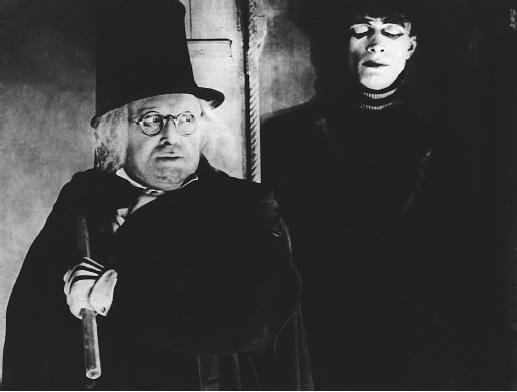
The Cabinet of Dr. Caligari (original German title: Das Cabinet des Dr. Caligari) released in 1920 and is said to be one of the most influential German silent films of the era. As a postmark of the German Expressionistic style, it uses geometrically unusual sets and art designs to convey a sense of insanity and madness. Writers Hans Janowitz and Carl Mayer insisted on using the Expressionistic style in order to properly convey the themes of the film and to evoke what the German people were feeling during the turbulent age of post-WWI Germany. 


You can see that the set is shaped in odd ways here. Sunlight is painted around the windows, and the rest of the room is a deeper, contrasting shade. Geometrically this shot is more round and flowing compared to other scenes, like this shot:


Everything is a bit more jagged here, representing the tensions that the general population was feeling and their franticness. The first screenshot shows Francis, the protagonist. Francis is presented as the sane person of this story-- the flowing geometry of his workspace seems to contribute to this depiction, as opposed to the majority of the other sets' jaggedness. 


The first time we see Francis running into the asylum may be an indication of his true nature. The floor and walls are very symmetrical; not in a way that defines sanity, but madness. The architecture and design lead to the center of the room, creating an image that (to me) confuses the mind further. Throughout the whole movie we see jagged shadows and lights painted onto the set as we learn about the truth of Dr. Caligari. However, when it is revealed at the end of the film that Francis himself is the insane individual, we learn this fact in this very room. As Francis is drawn to the middle of the room by Jane, his madness is revealed. Thus the floor design and symmetry of the room all points to him. 

The six act structure of the film, combined with the interesting imagery, makes it pretty darn viewable in an age where colorful lights and crazy soundtracks are needed to hold the interest of many audiences.  It's also important to note that this one of the first instances in film where a framed story is used to reveal the protagonist's altered mental state at the end of the film. Since this story telling method is seen in a lot of modern films, the importance of viewing this film is made that much more significant.